
Which OnSite Adjustable Climbing Wall Is Right for You?

Not all adjustable training walls are made equally. At OnSite, we offer three different wall products, each built around different needs for gym owners and home climbing enthusiasts. While they all give you the ability to change the angle of your climbing surface, the main differences come down to how they’re supported, where they can be installed, and how you plan to use them.
In this article, we’ll go through the Custom Adjustable Wall, the Legged Wall, and the HomeWall 2.0 to help you understand which one would work best in your space.
OnSite Adjustable Climbing Walls at a Glance
Wall | Best suited to | Key feature |
Custom Adjustable Wall | Commercial gyms seeking a tailored installation | Customizable design integrated into the building’s structure |
The Legged Wall | Gyms needing a freestanding training wall | Independent support frame |
The HomeWall 2.0 | Homeowners creating a personal climbing space | Home-focused design with two angle adjustment options |
OnSite Custom Adjustable Wall: Designed For You
Our pinnacle product, the OnSite Custom Adjustable Wall, is a fully customizable adjustable wall that integrates directly into the structure of your building. This gives gym owners the most flexibility when it comes to the design, colours, and layout of their wall.
Because the wall is designed around your building, it can accommodate spaces where a standard configuration might not be the best fit. This could mean working around an existing structure, fitting into a tighter area, or creating a larger training wall that becomes a main feature of your gym. The idea is to build around the space you have and what you want to do with it.
From here, you can choose the type of climbing setup you want to offer. The Custom Adjustable Wall supports Grasshopper, Kilter, Tension, and spray wall hold patterns. If your community already has a preferred board, you can build around that. If you want your setters to create their own training problems, a spray wall gives them that freedom.
The wall uses electric actuators that have a maximum of 55° of adjustment with option from 0° to 55°, 15° to 70° or -10° to 45°, with a 7-inch touchscreen controlling the angle. This allows climbers to change the steepness throughout a session, whether they’re warming up, working on a specific movement, or trying the same problem at a harder angle.
For gym owners who can attach to their building and want control over the final design, the Custom Adjustable Wall offers the most room to make the wall their own.

OnSite Legged Wall: A Freestanding Climbing Wall for Your Gym
What happens when you’re prohibited from attaching something to your building? Or when the ideal place for your wall is in the centre of your gym?
The OnSite Legged Wall addresses this by supporting the climbing surface on its own freestanding frame. This means it doesn’t require attachment to your building’s structure, giving you more options when deciding where your training area should go.
The Legged Wall allows you to plan your training area around a separate structure. You’ll still need to account for the full frame, the movement of the wall, and the landing area when deciding where it will fit.
The Legged Wall comes in 8x12, 12x12 and 16x12 configurations with 24x14 on its way, with black or birch finishes. Like the Custom Adjustable Wall, it supports Grasshopper, MoonBoard, Kilter, Tension, and spray wall hold patterns, and uses the same electric actuators as the Custom Adjustable Wall that have a maximum of 55° of adjustment with option from 0° to 55°, 15° to 70° or -10° to 45° through a 7-inch touchscreen.
It’s also designed with self-installation in mind and requires a 120V electrical supply. Holds and flooring aren’t included, so these are things you’ll need to consider alongside the wall itself.
The main reason to choose the Legged Wall is its independent support frame. If attaching to your building isn’t an option, or simply doesn’t suit the layout you have in mind, this is the wall to consider.5° through a 7-inch touchscreen.

OnSite HomeWall 2.0
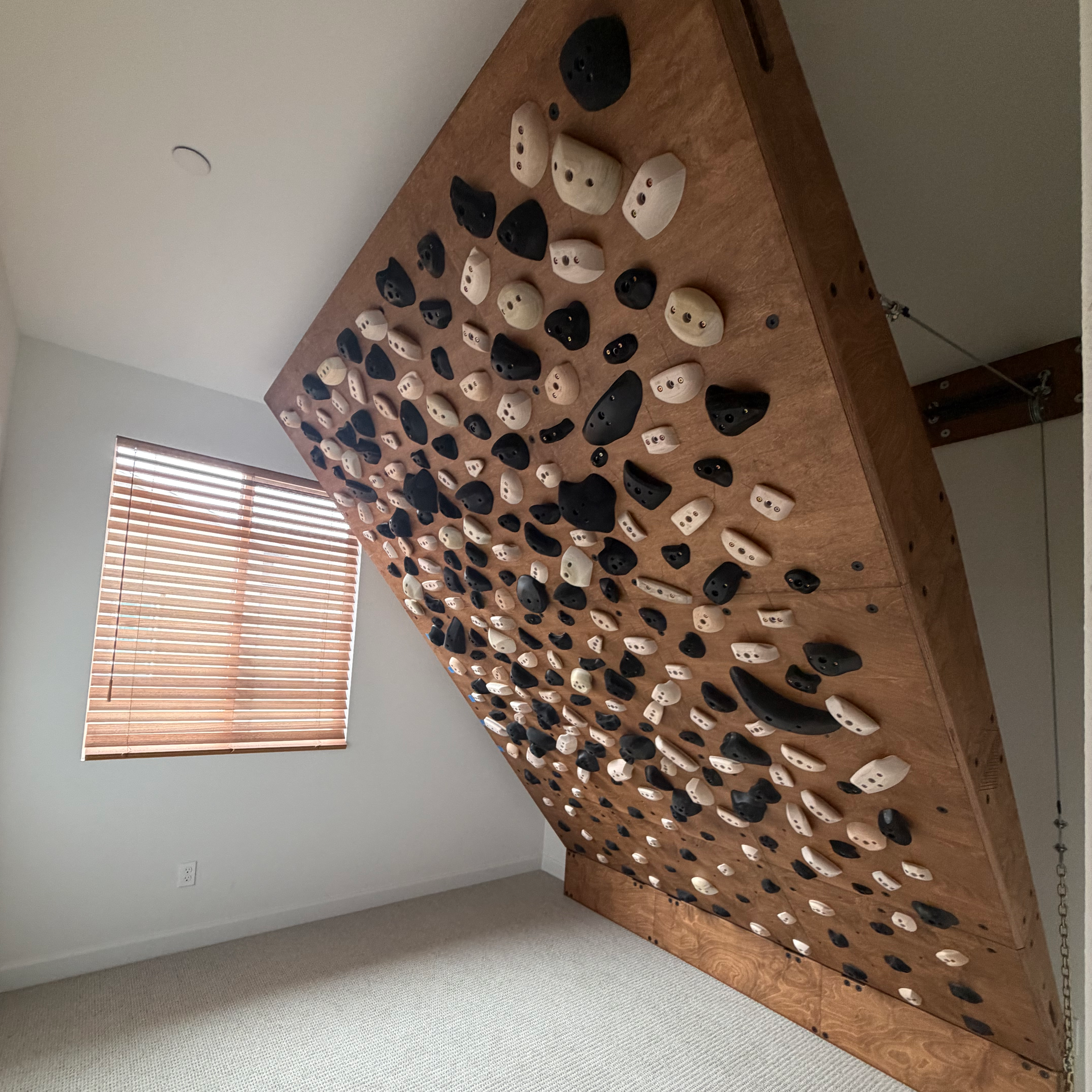
For everyone who dreams of climbing at home, this one is for you. The HomeWall 2.0 is OnSite’s home climbing solution, built from the ground up around the needs of homeowners.
Drawing on more than a decade of commercial climbing wall production, the HomeWall 2.0 takes what we’ve learned from building gyms and adjustable walls and applies it to home use. This includes thinking about how the wall looks, how much room it takes up, and how you’ll adjust it.
A climbing wall will naturally become a centrepiece of the room it’s in. With this in mind, the HomeWall 2.0 has a clean design and a range of colour options to help it fit your space. When you’re finished climbing, the wall can be moved to its least steep position, and the optional custom padding can be folded and stored away. This is particularly useful if climbing isn’t the only thing you use the room for.
There are two options for adjusting the angle: fixed chains or an electric winch with side links.
Fixed chains work well if you plan to choose an angle and leave it there for the session. Changing the angle is a manual process that requires people to support the wall while another person repositions the chain connections. Because of this, it’s better suited to occasional adjustments.
The electric winch with side links is the more convenient choice if you want to change angles during your session just like a commercial wall. If moving between different steepnesses is part of how you like to train, this is an option worth considering.
The HomeWall 2.0 supports Kilter, Tension, MoonBoard, and custom spray wall layouts, with different wall sizes and their corresponding t-nut patterns available. Your choice will depend on both the board you want to climb on and the space you have at home.
Find the Right Adjustable Climbing Wall
The main thing to consider is how the wall will fit into your space. If you’re building a training area in a commercial gym and want a tailored design, the Custom Adjustable Wall gives you that flexibility. If you need a freestanding option, the Legged Wall provides its own support structure. For climbing at home, the HomeWall 2.0 is designed with that use in mind.
From there, you can work through the size, hold pattern, finish, and adjustment options that make sense for you.
If you’re unsure where to start, contact us at sales@theonsite.com. We’ll help you work through the options and find a wall that fits your space and how you want to climb.
Comments